
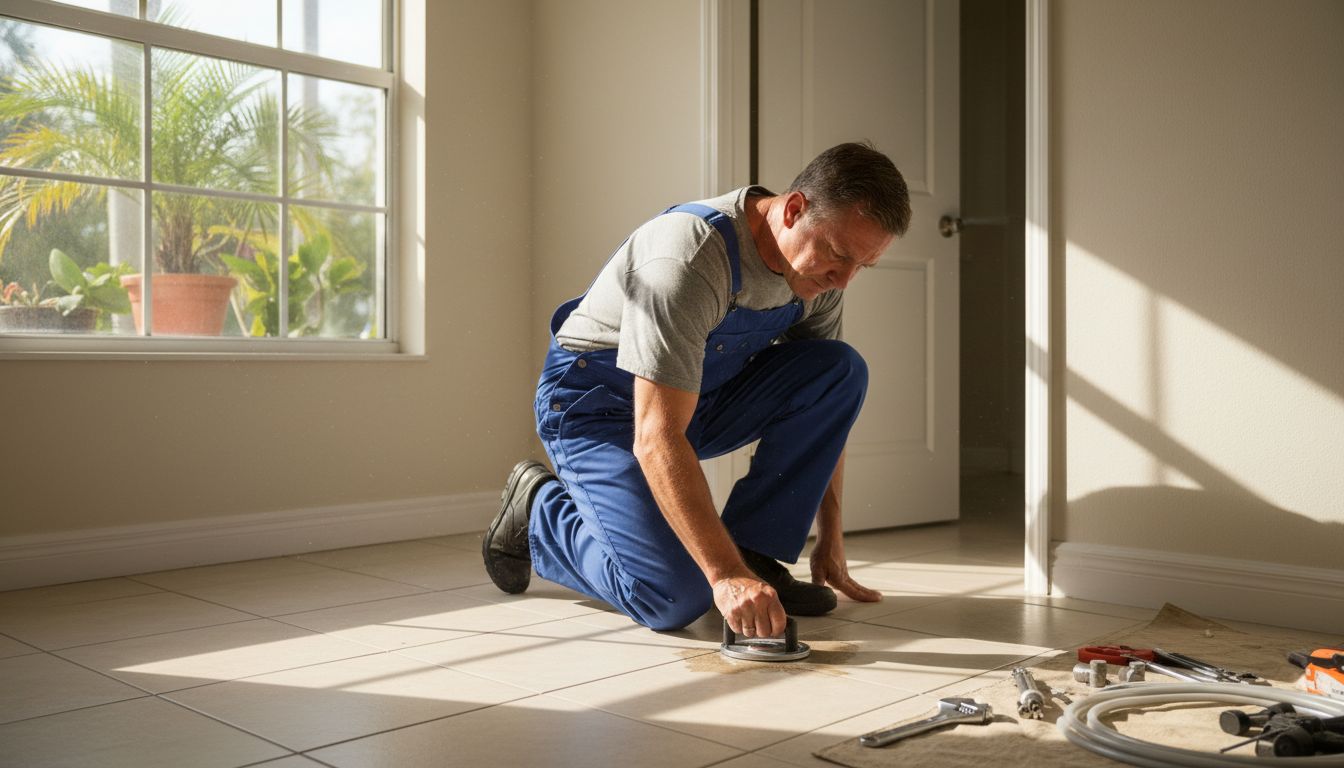
If you are trying to budget for water leak detection in Fort Lauderdale, the short answer is that detection itself usually runs a few hundred dollars, not a few thousand. National cost guides put the typical published range at roughly $100 to $500, with averages landing near $400 (HomeAdvisor, 2026). The repair that follows is a separate line item, and that is where the real spread lives. Here is how that plays out in a typical Fort Lauderdale home, so you know what you are paying for before you pick up the phone.
- Published typical cost for professional leak detection is about $100 to $500, averaging near $400 nationally.
- Detection and repair are two separate costs. Finding the leak is the small number; opening the wall or slab is the bigger one.
- Fort Lauderdale specifics - slab-on-grade construction, older cast iron and galvanized lines, and tight access - tend to push a job toward the upper end of that range.
- Always get the number in writing after a walkthrough, before any cutting or digging starts.
- Waiting is not free. The EPA puts average household leaks near 10,000 gallons of water a year.
The situation
Picture a common Fort Laudedale scenario: a 1970s single-story house west of Federal Highway, slab on grade, two bathrooms. The water bill climbs by a noticeable margin two months in a row, and nothing in the household routine has changed. No puddle, no dripping sound, no obvious culprit.
Then the smaller clues show up. One spot of tile in the hallway feels warm underfoot. The grout near the guest bath has darkened. The water meter dial keeps creeping even with every fixture shut off.
That combination - a rising bill plus a moving meter with everything off - is the classic signature of a hidden pressurized leak. At that point the homeowner is not shopping for a repair yet. They are shopping for an answer to one question: where exactly is it, and what will it cost to find out?
What water leak detection typically costs
Leak detection is priced as its own service because it is its own skill. A technician is using acoustic listening equipment, pressure testing, and meter isolation to narrow a leak down to a specific point before anything gets opened up. The published national range of roughly $100 to $500 reflects how much narrowing the job requires.
Here is how that published range usually breaks down by scenario. These are general industry ranges, not our posted prices - your own number comes from the written quote after we walk the property.
| Scenario | What the visit usually involves | Where it tends to land in the published range |
|---|---|---|
| Visible or accessible leak (under-sink supply, exposed valve, water heater connection) | Quick visual confirmation, isolation, no specialty equipment | Lower end |
| Leak inside a wall or ceiling | Moisture readings and acoustic listening across multiple bays to pinpoint one spot | Low to middle |
| Suspected leak under the slab | Meter isolation, pressure testing, acoustic sweep of the slab, often room by room | Middle to upper end |
| Main or buried line between meter and house | Meter test plus line tracing across the yard or driveway | Upper end |
What the process looks like
A detection visit should be methodical, not a guessing game with a sledgehammer. In a house like the one above, the sequence usually runs like this:
- Interview and walkthrough. Bill history, when the warm spot appeared, any past plumbing work, where the manifold and shutoffs are.
- Meter isolation. Shut the house valve and watch the meter. If it still moves, the leak is on the service line. If it stops, the leak is inside.
- Pressure test. Isolate the hot and cold sides to tell us which system is losing pressure. A warm floor spot usually points to the hot line.
- Acoustic pinpointing. Listening across the slab or wall surface to find the loudest point of escaping water, then marking it.
- Written findings and quote. Location marked, cause explained, and the repair priced in writing before anything is opened.
Step five is the one homeowners should insist on. Detection ends with a marked spot and a number, not with an open hole and an unknown bill.
What moves the number in Fort Lauderdale
Local building reality does affect where a job sits inside that published range. A few things come up repeatedly in Fort Lauderdale, Dania Beach, Hollywood, Davie, and Hallandale Beach:
- Slab-on-grade construction. Most of the older single-story housing stock here sits directly on concrete, so supply lines run under the slab instead of through an accessible crawlspace.
- Aging supply and drain material. Older galvanized supply and cast iron drain lines fail at joints and in long runs, which means more area to sweep.
- Finished floor and tight access. Large-format tile, built-in cabinetry, and tiled showers add time to pinpointing and raise the cost of the repair that follows.
- Humidity and irrigation noise. Damp soil and a wet season make surface signs less reliable, so pressure testing carries more of the diagnostic weight.
What to expect afterward
In the scenario above, the realistic outcome is a pinpointed pinhole leak on the hot water line under the hallway, with the repair point marked on the tile. The homeowner then has a real decision in front of them: a targeted spot repair through the slab, or rerouting that line overhead to avoid cutting concrete.
Both options get quoted in writing. That second number is nearly always larger than the detection fee, because it involves demolition, plumbing, and putting the floor back. Knowing it before work starts is the entire point of paying for detection separately.
The flip side matters too. An unfound leak keeps billing you every month, and the EPA estimates the average household wastes close to 10,000 gallons a year to leaks. A few hundred dollars spent finding the source is usually cheaper than one more quarter of guessing.
How to keep the total cost down
Three things reliably reduce what you spend overall. First, call at the first clue - a moving meter or a warm floor spot, not after the baseboard swells. Second, bring your last two or three water bills to the visit, since the consumption curve helps narrow the search faster.
Third, handle detection and repair with the same licensed plumber so nothing gets re-diagnosed. If the leak is actively flooding, that is an emergency call rather than a scheduled one.
Get a written number for your home
I am a plumber & remodeler llc handles water leak detection and the plumbing repairs that follow across Fort Lauderdale, Dania Beach, Hollywood, Davie, and Hallandale Beach, with 24/7 emergency plumbing when a leak will not wait until morning. We also cover routine plumbing services, drain unclogging, and hydrojetting drain cleaning.
Call (954) 988-1251 to schedule a leak detection visit. We will walk the property, pinpoint the source, and put the findings and the repair cost in writing before any work begins. License CFC1433142.
Frequently Asked Questions
How much does water leak detection cost in Fort Lauderdale?
Professional leak detection typically falls in a published range of about $100 to $500, with national averages near $400 (HomeAdvisor, 2026). Where your job lands depends on how hidden the leak is. An accessible under-sink leak sits at the low end, while a suspected slab leak or a buried service line takes longer to pinpoint and sits higher. We provide your actual figure in writing after walking the property.
Is leak detection priced separately from the repair?
Yes. Detection is the diagnostic step that pinpoints the leak and marks it. The repair is quoted as its own line item once we know the exact location, depth, and what has to be opened to reach it. The repair is almost always the larger of the two numbers, which is why you want it in writing before work starts.
How do I know if I actually need leak detection or just a plumbing repair?
If you can see the leak, you need a repair. If your bill is climbing, your water meter keeps moving with every fixture shut off, you have a warm spot on the floor, or you smell musty air with no visible source, the leak is hidden and detection comes first. Guessing and cutting is usually more expensive than pinpointing.
Why are slab leaks more expensive to deal with in South Florida?
Much of the older housing stock in Fort Lauderdale and the surrounding cities is slab on grade, so water supply lines run under concrete instead of through an accessible crawlspace. That makes pinpointing more involved and the repair more invasive, since it can mean cutting and restoring finished flooring or rerouting the line overhead instead.
What if the leak is flooding the house right now?
Shut off the main water valve to the house and call us. We offer 24/7 emergency plumbing, so an active flooding leak is handled as an emergency call rather than a scheduled detection appointment. Stopping the water comes first, then we locate and repair the failure point.